
Thinking in systems, not structures
One of the recurring problems in temporary structures is that the point of stress is never consistent.
You might design for a heavy head load, then find the issue is ground conditions. Or design for ground stability, then encounter dynamic wind loading that shifts the critical point higher up.
“The mast survives because of the strength of the bottom bit here. But that in the next project might be the top bit.”
If you treat those as separate problems, you end up chasing edge cases.
The alternative is to design the structure so it behaves consistently regardless of where the stress is introduced.
That is what is happening here.
The base is not isolated from the rest of the mast. The interplates are not passive connectors. Every component participates in how load is managed.
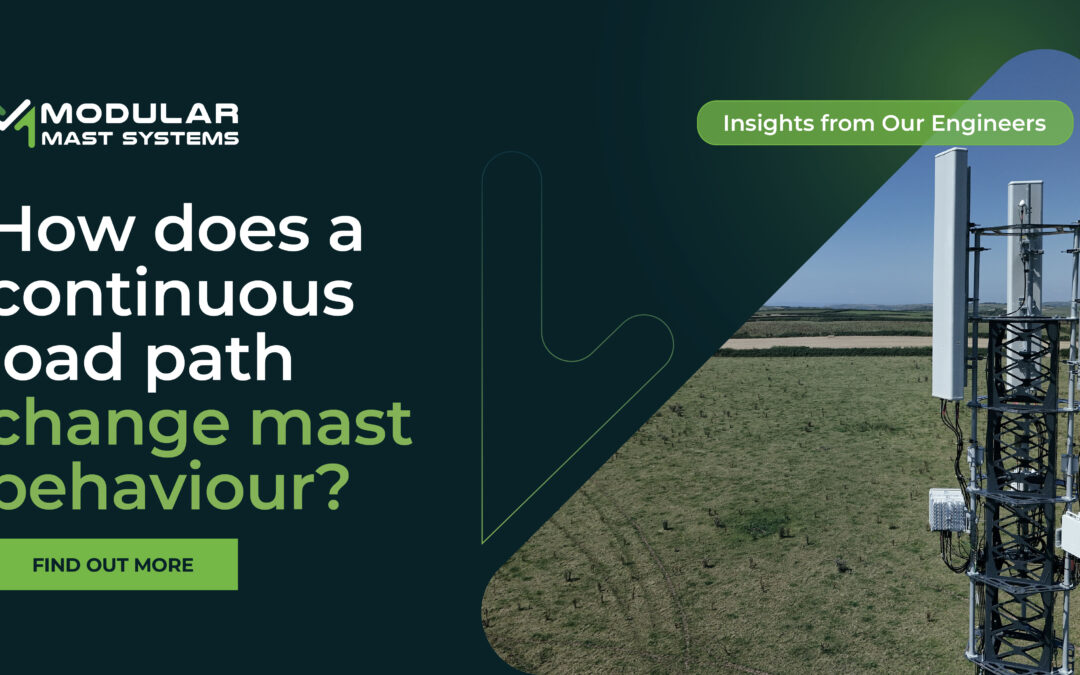
That creates a continuous load path rather than a series of discrete structural elements.
The benefit is scalability.
If you increase height, the behaviour does not fundamentally change. If you alter the load at the top, the response is still distributed. You are not redesigning the system for each scenario, you are applying the same structural logic at different scales.
That is why it starts to feel less like a single product and more like a framework.
Once the underlying behaviour is correct, you can extend it, adapt it or configure it without introducing instability.
That is also why there is less focus on versioning.
“No, there’s nothing else that we can do now.”
From an engineering standpoint, that usually means the core problem has been solved properly. Future changes become about application, not fundamental redesign.
If you’re dealing with inconsistent site conditions or evolving requirements, it’s worth discussing how a C4P system could simplify things.