
by mms-admin | Jul 7, 2026 | Latest News
Engineering for imperfect conditions Most structural calculations assume an ideal environment: Level ground Mild weather Uniform load distribution Controlled installation Those assumptions are necessary for modelling, and they may be adequate in principle, but they...

by mms-admin | Jul 1, 2026 | Latest News
Modularity as an engineering tool There is a tendency to treat modularity as a commercial feature rather than an engineering one. In practice, it is about reducing the time between: Requirement and solution Problem and repair Demand and supply When a different antenna...
by mms-admin | Jun 23, 2026 | Latest News
Thinking in systems, not structures One of the recurring problems in temporary structures is that the point of stress is never consistent. You might design for a heavy head load, then find the issue is ground conditions. Or design for ground stability, then encounter...

by mms-admin | Jun 16, 2026 | Latest News
96 Metres in a container: Designing for deployment A lot of structural design stops at performance. Once the structure works, the job is considered done. In reality, that is only part of it. Before anything is installed, it has to be stored, transported, handled,...

by mms-admin | Jun 9, 2026 | Latest News
Why this mast gets stronger as it gets taller When you design any vertical structure, you spend most of your time worrying about what happens at the base. Not because it is complicated, but because everything ends up there. Wind load, head load, dynamic movement, any...
by mms-admin | Jun 2, 2026 | Latest News
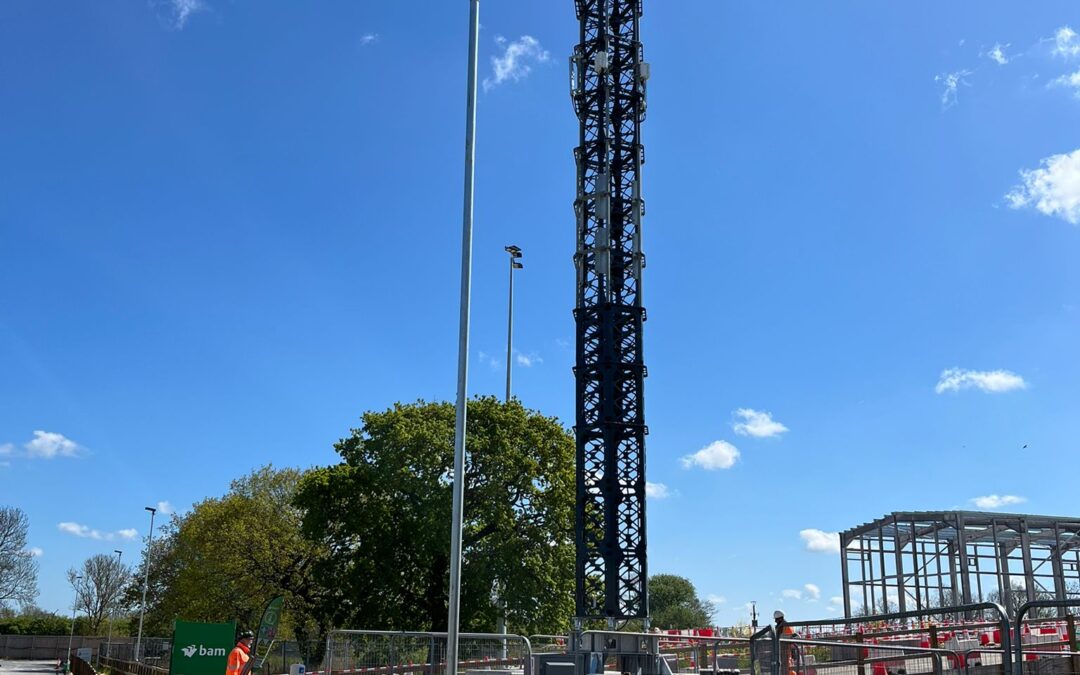
Modular Mast Systems Ltd is proud to announce its pivotal role in supporting the construction infrastructure for the landmark Eastern Green Link 2 (EGL2) project at Wren Hall, Drax. Working in close collaboration with principal contractor BAM UK & Ireland and...
