
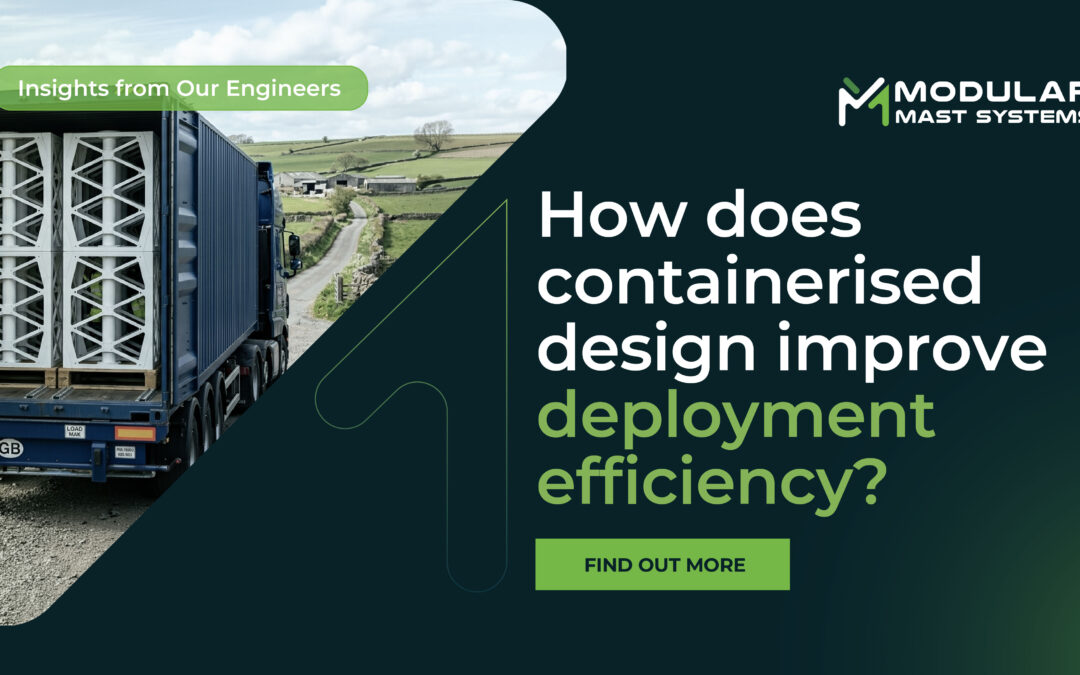
96 Metres in a container: Designing for deployment
A lot of structural design stops at performance. Once the structure works, the job is considered done. In reality, that is only part of it. Before anything is installed, it has to be stored, transported, handled, picked and delivered. Each of those stages introduces inefficiency, delay or risk if they are not designed properly. This system starts with packaging. Poles are stored inside the cube. Interplates are stacked separately. That allows six units to fit into a standard ISO container, which gives a very specific outcome.
“That’s 96 metres of mast in a 40-foot container.”
That number matters. Not because it sounds impressive, but because it defines how much usable infrastructure you can move in a single shipment. Compare that to traditional designs where geometry limits packing efficiency. You end up shipping partially empty space, which increases cost and reduces readiness. Here, the geometry has been engineered for shipping density as well as operational strength. The next step is deployment.
“If it was an out and out disaster, we could put a mast on site… inside 15 hours, 16 hours.”
That only works if everything upstream supports it. Components have to be standardised enough to be picked quickly. Assembly needs to be repeatable without interpretation. There cannot be dependency on specialist fabrication once you arrive on site. This is where logistics becomes an engineering problem. You are not just designing a structure. You are designing a system that moves efficiently from storage to operation with minimal friction. That includes warehousing, transport handling, on-site sequencing and assembly. The end result is not just faster deployment. It is more reliable deployment.Because when time is critical, complexity is the first thing that fails. If deployment speed, logistics or storage constraints are shaping your project, get in touch. We can walk through how C4P’s different configurations impact transport, readiness and on-site timelines.